








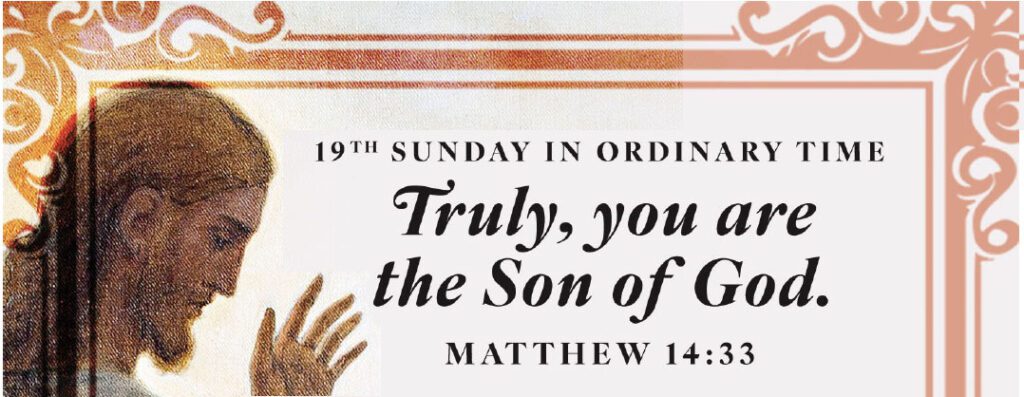
19th Sunday of Ordinary Time
The Hand that Commands the Sea is the Same Hand that Lifts Every Sinking Heart
(Nineteenth Sunday in Ordinary Time, Mathew 14:22-33, 09 August 2026)
In today’s Gospel, we are presented with the account of Jesus walking on the water of the lake (Mathew 14:22-23). After the multiplication of loaves and fish, He asks the disciples to get into the boat and go before him to the other side of the lake while He dismisses the crowds. He then goes up into the hills by himself to pray until late at night. Meanwhile a strong storm blows up on the lake and right in the middle of the storm Jesus reaches the disciples’ boat, walking upon the water of the lake. When they see him, the disciples are terrified, but He calms them: “Take heart, it is I; have no fear!” (Mathew 14:27). Peter, with his usual passion, practically puts him to the test: “Lord, if it is you, bid me come to you on the water”; and Jesus answers “Come!” (Mathew 14:28-29). Peter gets out of the boat and walks on the water; but a strong wind hits him and he begins to sink. And so, he yells: “Lord, save me!” (Mathew 14:30), and Jesus reaches out his hand and catches him. (Pope Francis, Angelus, 2014)
Dear Brothers and Sisters in Christ,
Faith Is Not the Absence of Storms but the Presence of Christ-Last Sunday’s Gospel presented Jesus multiplying five loaves and two fish to feed thousands. Today’s Gospel begins immediately after that miracle. Curiously, Jesus does not allow the disciples to remain in the atmosphere of success and admiration. Instead, He “made the disciples get into the boat” while He withdrew alone to pray (Mt 14:22-23). Before teaching them how to become fishers of men, He first teaches them how to survive the storms of faith. The Sea of Galilee, though beautiful, was notorious for sudden storms. The disciples, many of whom were experienced fishermen, knew the lake well. Yet experience alone was not enough to save them. Nature suddenly reminded them that human competence has limits.
Matthew’s Gospel is not merely recounting a historical miracle. The boat represents the Church. The sea symbolizes the uncertainties of history. The storm signifies every form of suffering, fear, doubt, loneliness, sickness, financial anxiety, broken relationships, and even spiritual darkness. Every Christian eventually finds himself in that boat. The remarkable truth is this: Jesus deliberately allowed the disciples to encounter the storm—not to destroy them but to deepen their trust in Him. God often educates faith not in calm waters but amid turbulent waves.
Christ Often Comes to Us Through the Very Storms We Wish to Escape-Human logic assumes that God’s presence should eliminate difficulties. The Gospel reveals something profoundly different. Jesus does not prevent the storm. He comes through the storm. This is one of the deepest paradoxes of Christian life.
Philosophically speaking, suffering often appears meaningless because we evaluate reality only through immediate experience. Yet Christian philosophy teaches that reality possesses dimensions beyond what is immediately visible. What appears as chaos may actually conceal providence. Saint Augustine beautifully reminds us: “God is closer to us than we are to ourselves.” Even when invisible, Christ remains profoundly present. The disciples believed they were abandoned because Jesus was not physically in the boat. Yet He had never stopped watching over them. From the mountain where He prayed, His loving gaze remained fixed upon them. How often we make the same mistake! When our prayers seem unanswered when illness persists when families struggle, when children drift away from faith, when retirement becomes lonely, when our plans collapse, we easily conclude that God has forgotten us. Yet the Gospel says otherwise. The God who seems absent is often preparing His most astonishing manifestation. Notice the timing. Jesus comes during “the fourth watch of the night”—between three and six in the morning—the darkest hours before dawn. God frequently arrives when human hope has almost disappeared.
“Take Heart, It Is I”: The Divine Answer to Human Fear-The disciples first mistake Jesus for a ghost. Fear distorts perception. Whenever anxiety dominates the human heart, reality becomes blurred. Fear has the strange ability to transform blessings into threats and opportunities into dangers. Immediately Jesus speaks: “Take heart, it is I; have no fear.” (Mt 14:27) These words contain far more than consolation. The expression “It is I” echoes God’s revelation to Moses: “I AM WHO AM.” Jesus is quietly revealing His divine identity. The One standing upon the waters is not merely a miracle worker. He is the Lord of creation itself. Throughout Scripture, only God has authority over the sea. In biblical symbolism, the sea often represents chaos, evil, uncertainty, and death. Jesus walks upon it. He does not merely survive chaos. He rules over it. Philosophically this reveals an important truth. Human beings constantly seek control because uncertainty frightens us. Yet complete control is an illusion. No one controls tomorrow. Faith is therefore not control. Faith is confidence in the One who controls what we cannot. Peace comes not because the sea becomes calm, but because Christ stands above the sea.
Peter’s Courage and Peter’s Failure Mirror Every Christian Life-Peter responds with characteristic boldness: “Lord, if it is you, command me to come to you on the water.” Jesus simply replies: “Come.” What extraordinary trust! Peter actually walks upon the water.
Too often we remember only Peter’s failure. We forget that he was the only disciple who dared to leave the safety of the boat. The boat is comfortable. The boat is predictable. The boat represents every false security we build around ourselves. Many people never truly encounter God because they never leave the comfort of the boat.
Philosophically, authentic existence always requires transcendence. Human beings grow only when they move beyond self-protection toward self-giving. Faith always demands risk. Peter’s mistake was not stepping out. His mistake came afterward. Matthew tells us: “Seeing the strong wind, he became frightened.” The problem was never the wind. The wind had been blowing from the beginning. What changed was Peter’s attention. He shifted his gaze from Christ to the storm. The same thing happens in our spiritual lives. We begin with enthusiasm. Then we focus more on our problems than on God’s promises. More on statistics than hope. More on weakness than grace. More on ourselves than Christ. Where attention goes, the heart follows. Faith weakens whenever Christ ceases to be the center of our vision.
The Hand That Saves Is Faster Than the Waves That Sink-Peter begins to sink. Notice something beautiful. He does not offer a long prayer. He simply cries: “Lord, save me!” Three words. Short. Honest. Desperate. Perfect. Sometimes our greatest prayers are our shortest.
The Catechism teaches that authentic prayer is born from humility. Peter has reached the point where self-confidence collapses. Only then does divine grace become fully operative. Matthew immediately says: “Jesus stretched out His hand and caught him.” Immediately. Not eventually. Not after Peter proved himself. Not after a lecture. Immediately. This is perhaps the most consoling sentence in today’s Gospel.
The hand that created the stars now reaches into the water for one frightened fisherman. That same hand reaches into every human life today. Into hospital rooms. Into nursing homes. Into struggling marriages. Into anxious parents. Into discouraged young people. Into those burdened by sin. Into every lonely heart. God’s grace is always quicker than our despair.
The philosopher Gabriel Marcel once distinguished between a “problem” and a “mystery.” A problem is something outside us to be solved. A mystery is something in which we ourselves participate. Suffering is not merely a problem to solve but a mystery through which God transforms us. Christ does not remain outside our struggles; He enters them and extends His saving hand. No one is beyond the reach of that hand.
The Church Continues to Sail Through Storms-The boat has always symbolized the Church. Throughout history the Church has faced persecution, scandals, divisions, wars, cultural opposition, and internal weakness. Yet the boat has never sunk. Not because the disciples were perfect. But because Christ never abandoned it. The same applies to every Christian family. Every parish. Every vocation. Every individual believer. Storms are inevitable. Shipwreck is not.
As Pope Francis beautifully reflected on this Gospel, Peter’s cry, “Lord, save me!”, becomes the prayer of every believer who discovers that salvation comes not from personal strength but from the outstretched hand of Christ. Faith grows whenever we allow ourselves to be grasped by that saving hand rather than relying only upon ourselves. Finally, when Jesus enters the boat, the wind ceases. The disciples fall down in worship and proclaim: “Truly you are the Son of God.” Notice the progression. Storm. Fear. Faith. Worship. Sometimes we do not truly recognize Christ’s divinity until we have experienced His saving power. The deepest theology is often learned not in classrooms but in storms.
Conclusion: Keep Your Eyes on the Hand That Never Lets Go-Dear brothers and sisters, every one of us carries some hidden storm. Perhaps no one else knows it. But Christ knows. Today’s Gospel leaves us with one unforgettable image—not merely Jesus walking upon the sea, but Jesus stretching out His hand toward a sinking disciple.
That hand has never been withdrawn from humanity. It lifted Peter. It raised Jairus’ daughter. It blessed little children. It touched lepers. It broke bread at the Last Supper. It was pierced upon the Cross for our salvation. It rose gloriously on Easter morning.
And today, through the Eucharist, that same hand continues to nourish, strengthen, forgive, and lift every heart that cries, “Lord, save me.” Let us therefore never measure God’s presence by the absence of storms. Instead, let us measure His love by the certainty of His outstretched hand. For the hand that commands the sea is indeed the same hand that still lifts every sinking heart.
Fraternally,
Fr. John Peter Lazaar SAC, Pastor