








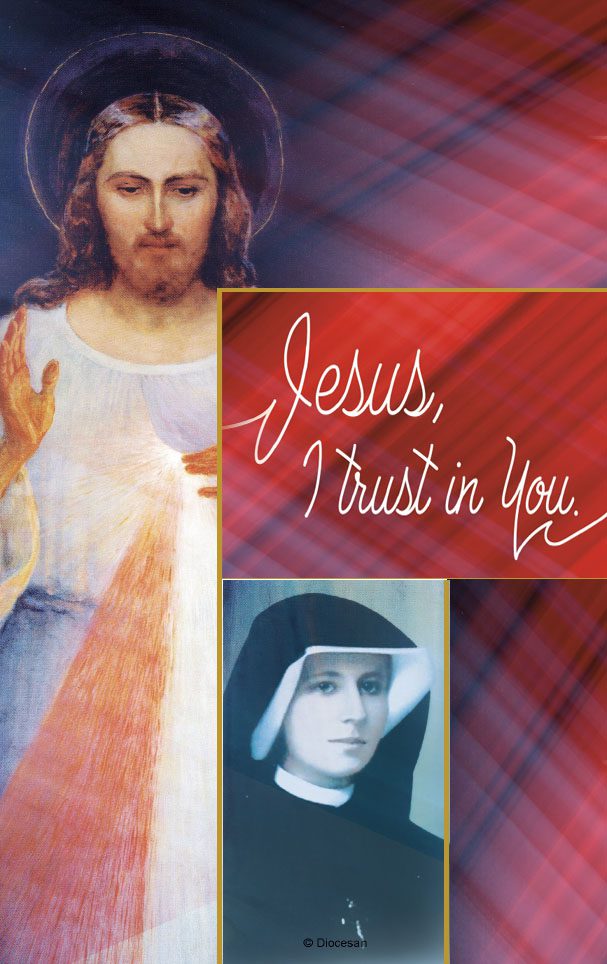
Divine Mercy Sunday
Dear Brothers and Sisters in the Lord
From Christ’s Wounds: The Fountain of Healing Divine Mercy Flows
(Second Sunday of Easter or Divine Mercy Sunday, John 20:19-31, 12 April 2026)
Today, Divine Mercy Sunday, the Gospel recounts two apparitions of the Risen Jesus to his disciples, and in particular, to Thomas, the “doubting Apostle” (John 20:19-31). Touch Jesus’ wounds, which are the many problems, difficulties, persecutions, illnesses of so many suffering people. Are you not at peace? Go. Go to visit someone who is the symbol of Jesus’ wounds. Touch Jesus’ wounds. Mercy flows from those wounds. That is why today is the Sunday of Mercy. A saint used to say that Jesus’ crucified body is like a bundle of mercy, which reaches each of us through his wounds. All of us need mercy, as we know. Let us draw near to Jesus and touch his wounds in our suffering brothers and sisters. Jesus’ wounds are a treasure: mercy issues from them. (Pope Francis, Angelus, 2019)
The Risen Christ Appears in the Midst of Fear-The Gospel of the Second Sunday of Easter presents a powerful and deeply human scene. The disciples are gathered in a locked room, paralyzed by fear, uncertainty, and grief. The crucifixion had shattered their hopes. The Master whom they loved had been executed, and their dreams seemed buried in the silence of the tomb. They feared persecution, rejection, and the unknown future. Into this atmosphere of anxiety and isolation, the Risen Christ suddenly appears and speaks the words that echo through every generation of believers: Peace be with you. (John 20:19). These words are not merely a greeting. They are the proclamation of a new reality. The Resurrection reveals that death, fear, and despair do not have the final word in human history.
The disciples represent humanity in every age. Today many people also live behind locked doors—doors of loneliness, discouragement, illness, and uncertainty. Many elderly people live alone, separated from family or community. Many suffer silently with sickness, grief, or abandonment. Entire neighborhoods experience the quiet sadness of changing demographics, empty pews, and fading communal bonds. Yet the Gospel assures us that Christ enters precisely such rooms. The Risen Lord does not wait for perfect conditions. He comes into our fears, into our wounded communities, into our fragile human situations. Divine Mercy is born exactly in those moments where human strength fails.
Anecdote for Divine Mercy Sunday-A priest once visited an elderly parishioner who had not been seen at Mass for many months. She lived alone in a small house at the edge of the neighborhood. Age and illness had confined her indoors, and the quiet rooms of her home had slowly become a place of loneliness. When the priest arrived, she said softly, “Father, I used to come to church every Sunday, but now I feel forgotten. I cannot walk easily anymore, and sometimes I wonder whether anyone remembers me.” The priest sat beside her and spoke about the Gospel of Thomas touching the wounds of Christ. He told her that the Risen Jesus did not hide His wounds; instead, He showed them as signs of love. Then he said something simple but profound: “Today I came here to touch one of the wounds of Christ.” The woman looked surprised and asked, “What do you mean?” The priest replied gently, “Christ’s wounds are present wherever someone suffers or feels alone. When we visit those who are sick, when we listen to those who are lonely, when we bring the Eucharist to those who cannot come to church—we are touching the wounds of the Risen Lord.” Tears filled the woman’s eyes. For the first time in months, she smiled. She realized that her suffering was not meaningless and that she had not been forgotten by God. That day, the priest prayed with her and brought her Holy Communion. Before leaving, he said, “Mercy flows wherever Christ’s wounds are touched with love.” That simple visit transformed the atmosphere of that home. The loneliness that had filled the house was replaced by a quiet peace.
This small story captures the heart of Divine Mercy Sunday: Christ’s mercy flows not only in great miracles but also in simple acts of presence. When we visit the sick, accompany the elderly, listen to the lonely in our Epiphany neighborhood, and welcome the forgotten, we become witnesses that the wounds of Christ, are still fountains of mercy for the world.
The Wounds of Christ: Signs of Mercy, Not Defeat-After greeting the disciples with peace, Jesus performs a surprising gesture: He shows them His wounds (John 20:20).From a purely human perspective, wounds signify defeat. They are marks of suffering, vulnerability, and humiliation. But in the mystery of the Resurrection, the wounds of Christ become something entirely different. They are no longer signs of destruction but signs of love.
Saint Thomas Aquinas wrote that Christ retained His wounds after the Resurrection not as imperfections but as eternal trophies of His love. They are reminders that redemption came through sacrifice. The wounds reveal that the power of God is not expressed through domination but through self-giving love. Divine Mercy flows from these wounds because they reveal the depth of God’s compassion for humanity. As the mystic tradition of the Church often reminds us, the pierced side of Christ is the open heart of God. From this heart flows forgiveness, reconciliation, and healing. Saint Faustina Kowalska, whose visions inspired the celebration of Divine Mercy Sunday, heard Christ say: “The greater the sinner, the greater the right he has to My mercy.” Mercy is therefore not a reward for perfection but a gift offered to human fragility.
The wounds of Christ teach us that suffering does not destroy meaning; it can become a place where grace emerges. Even the most painful experiences—illness, loneliness, rejection—can become openings through which divine love enters human life.
Thomas and the Journey from Doubt to Faith-The Gospel also recounts the story of Thomas, often remembered as the “doubting apostle.” Thomas was absent when Jesus first appeared. When the other disciples told him about the Resurrection, he responded with skepticism: “Unless I see the mark of the nails in his hands and put my finger into the nail marks and put my hand into his side, I will not believe.” (John 20:25)
Thomas represents a deeply human desire: the longing for certainty. Faith, however, often grows precisely through the tension between doubt and trust. The Gospel does not condemn Thomas. Instead, it reveals that Christ meets him exactly where he stands.
Eight days later, Jesus appears again and invites Thomas to touch His wounds: “Put your finger here and see my hands. Bring your hand and put it into my side.” (John 20:27) This invitation reveals something profound about Divine Mercy. God does not reject our questions. He does not condemn our struggles. Instead, He invites us to approach Him honestly and personally. Thomas responds with one of the most beautiful professions of faith in the entire Gospel: “My Lord and my God!” (John 20:28) Faith is born not from abstract ideas but from encounter. Thomas moves from doubt to faith because he meets the living Christ. Divine Mercy always begins with such encounters—moments when the human heart recognizes the presence of God’s love.
Divine Mercy in a Wounded World-Divine Mercy Sunday invites Epiphany community to contemplate how the mercy of Christ touches the concrete wounds of our world. Our neighborhoods and communities carry many forms of suffering.
Many elderly people experience isolation as families move away and familiar social networks disappear. Illness and physical limitations often confine individuals to solitude. The rapid transformation of urban and suburban landscapes has changed the fabric of many parishes. Houses once filled with large families may now stand empty or occupied by transient residents.
Churches that once overflowed with worshippers sometimes struggle with declining attendance. These realities can easily lead to discouragement. Some may ask whether faith still has a place in modern society. Divine Mercy offers a different perspective. It reminds us that the Epiphany parish is not measured merely by numbers but by love. Mercy transforms communities not through power or prestige but through compassion and presence.
Whenever someone visits a lonely neighbor, listens to the struggles of a suffering friend, or reaches out to the forgotten, the mercy of Christ becomes visible. Divine Mercy is therefore not only a theological concept; it is a lived reality. It is the concrete expression of Christ’s love in daily life.
Touching the Wounds of Christ Today-Pope Francis once reflected on this Gospel by encouraging Christians to “touch the wounds of Jesus in the suffering of others.” The wounds of Christ are no longer only the marks in His resurrected body. They are also present in the wounded humanity around us.
The elderly person living alone carries the wound of abandonment. The sick person carries the wound of physical suffering. The discouraged believer carries the wound of spiritual doubt. The struggling family carries the wound of economic or emotional burden. When we encounter these wounds with compassion, we encounter Christ Himself. Mercy becomes the bridge that connects faith with life.
Saint John Paul II once wrote in his encyclical Dives in Misericordia that mercy is the “most profound source of justice.” Justice seeks order, but mercy restores relationship. It heals what has been broken. It gives hope where despair threatens to prevail.
For our Epiphany parish community, Divine Mercy means becoming a place where people experience welcome, healing, and belonging. A parish is not simply a building where liturgy occurs; it is a living community where Christ’s mercy is shared.
Mercy as the Heart of Christian Mission-The Resurrection entrusted a mission to the disciples. After greeting them with peace, Jesus breathed upon them and said: “Receive the Holy Spirit. Whose sins you forgive are forgiven them.” (John 20:22–23). This moment reveals that mercy is not only received—it is also entrusted. The Church becomes the instrument through which God’s forgiveness reaches the world. Every member of Epiphany parish is therefore called to participate in the ministry of mercy. In a culture often marked by judgment, competition, and indifference, mercy becomes a revolutionary force. Mercy restores dignity to those who feel invisible. Mercy heals relationships damaged by resentment. Mercy creates spaces where hope can grow again. When our Epiphany parish becomes a community of mercy, it becomes a sign of the Resurrection in the world.
The Quiet Power of Hope-Divine Mercy does not always appear through dramatic miracles. Often it works quietly and gradually. A conversation, a small act of kindness, a patient presence beside someone who suffers—these are the humble ways in which mercy transforms human life in Epiphany community.
In the Gospel, the disciples begin the day in fear and end it in joy. Their transformation happens because Christ stands among them. The same transformation can occur within Epiphany community. Even when pews appear emptier than before, even when the neighborhood changes, the presence of Christ remains the same. Where Christ is present, hope remains alive in Epiphany parish. Mercy is therefore the language through which the Resurrection continues to speak to Epiphany community and to the world.
Cumulative Summary-The Gospel of the Second Sunday of Easter reveals the Risen Christ entering a room filled with fear and speaking the words, “Peace be with you.” By showing His wounds, Jesus reveals that suffering, once transformed by love, becomes the very source of mercy and healing. Divine Mercy Sunday therefore invites us to contemplate the mystery that from the pierced heart of Christ flows forgiveness, hope, and renewal for the whole world. The encounter of Thomas with the wounds of the Risen Lord teaches that faith is born not from certainty alone but from a personal encounter with the living Christ who meets us in our doubts and struggles of Epiphany neighborhood. This message becomes particularly meaningful in the context of our own neighborhoods and parish communities. Many people today experience forms of isolation similar to the disciples behind locked doors—elderly persons living alone, those suffering from illness, individuals burdened by loneliness, and communities experiencing shifting demographics and empty pews. Divine Mercy reminds us that Christ continues to enter these spaces of fear and discouragement with His gift of peace. The anecdote of the priest visiting a lonely elderly parishioner illustrates how the wounds of Christ remain present in human suffering. When the priest said that he had come to “touch one of the wounds of Christ,” he revealed the deeper truth that mercy becomes real whenever we accompany those who suffer. In visiting the sick, listening to the lonely, and offering simple gestures of compassion, the Church becomes a living sign of the mercy that flows from the Risen Lord. Thus, Divine Mercy Sunday calls Epiphany the parish to become a place where Christ’s compassion is visible and tangible. Through acts of presence, prayer, and service, the wounds of Christ become fountains of healing for the wounded of our world. Wherever mercy is practiced, hope is restored, loneliness is softened, and the Resurrection continues to unfold quietly in the life of the community.
Living the Mystery of Divine Mercy-Divine Mercy Sunday ultimately invites us to contemplate a profound mystery: God responds to human weakness not with rejection but with love. The wounds of Christ reveal that the deepest truth about God is mercy. In the midst of suffering, illness, loneliness, and social change, this message remains profoundly relevant. Divine Mercy reminds us that no human life is forgotten, no suffering is meaningless, and no darkness is final. The Risen Christ still enters locked rooms. He still speaks words of peace. He still shows His wounds as signs of love. And He still invites humanity to encounter the healing power that flows from His heart. Therefore, on this Divine Mercy Sunday, the Epiphany community is invited to approach Christ with trust and to become instruments of His compassion in the world: For wherever mercy is practiced, the Resurrection continues to unfold. Wherever wounds are touched with love, Christ becomes present again. And wherever hope rises from despair, the fountain of Divine Mercy flows anew.
Fraternally,
Fr. John Peter Lazaar SAC, Pastor