








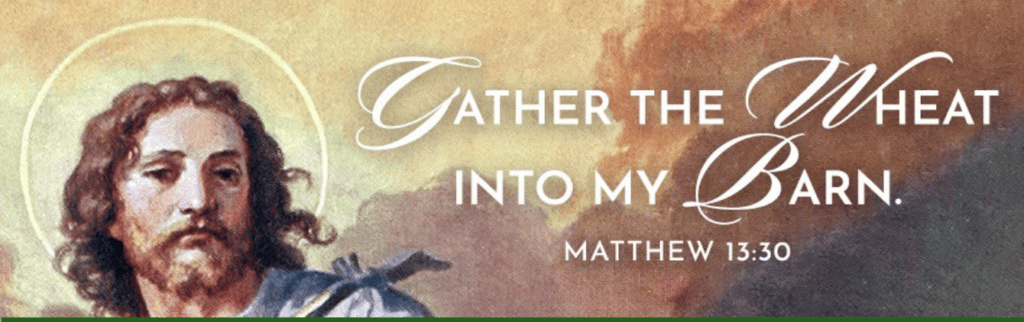
16th Sunday in Ordinary Time
Where Humanity Sees Weeds: God Still Sees the Possibility of Wheat
(Sixteenth Sunday in Ordinary Time, Mathew 13:24-43; 19 July 2026)
In today’s Gospel (Mathew 13:24-43) we once again encounter Jesus who is intent on speaking to the crowd in parables about the Kingdom of Heaven. I will reflect only on the first one, that of the weeds, through which Jesus helps us understand God’s patience, opening our hearts to hope. Jesus narrates that, in the field where the good seed was sown, weeds also sprouted. This term sums up all the toxic vegetation that infests the soil. Among us, we can say that even today the soil has been devastated by so many herbicides and pesticides that, in the end, harm the grass, the soil and our health. But this is parenthetical. The servants then go to the master to understand where the weeds come from. He responds: “An enemy has done this!” (Mathew 13:28). (Pope Francis, Angelus, 2020)
Dear Brothers and Sisters,
The Patience of God Is the Hope of Humanity-The Gospel today presents one of the most realistic and hopeful parables Jesus ever told—the Parable of the Wheat and the Weeds. It is a parable that does not romanticize the world. Jesus never pretends that evil does not exist. Rather, He teaches us how God acts in the presence of evil. The servants are disturbed because the field that should have been filled only with wheat has become contaminated by weeds. Their immediate solution is straightforward: pull out the weeds. Eliminate the problem. Remove the imperfect. Yet the master surprises them. “No; lest in gathering the weeds you root up the wheat along with them. Let both grow together until the harvest.” (Mathew 13:29-30) This response overturns ordinary human reasoning. Humanity measures quickly; God measures patiently. Humanity judges appearances; God contemplates possibilities. Humanity seeks immediate solutions; God patiently accompanies history toward redemption.
Pope Francis beautifully observed that an enemy has indeed sown weeds into God’s field. Evil is real. Sin is real. Division is real. Yet God’s answer is not despair but patience—a patience that keeps hope alive because He never ceases believing that wheat can emerge even where weeds seem dominant. The Kingdom of Heaven therefore is not the absence of evil. It is God’s patient love triumphing over evil.
Pastoral Anecdote: The Farmer Who Waited-An elderly farmer was once asked why he never hurried to plow under a section of his field that appeared overrun with weeds. Looking across the land, he smiled and said, “My father taught me never to judge a field too early. What looks like weeds in spring often hides healthy grain beneath. If I uproot everything that appears useless, I may destroy the very harvest I have been praying for.”
That autumn, when the crops were gathered, the very patch that had seemed most hopeless yielded some of the richest wheat on the farm. The impatient neighbors were astonished. The old farmer simply replied, “The field needed time, not condemnation.”
Our lives are much like that field. We often look at ourselves or others and notice only failures, weaknesses, broken relationships, or repeated sins. We are tempted to conclude that nothing good can come from such lives. But God is not as impatient as we are. He sees beneath the surface. He sees the hidden seeds of grace, the silent struggles, the sincere repentance, and the possibilities that only His mercy can bring to maturity.
The Gospel reminds us that while people may quickly label someone as “weeds,” God lovingly waits for the wheat to grow. His patience is not delay—it is hope in action.
The Human Heart Is a Field of Mixed Growth-Every philosophy attempts to answer one fundamental question: What is the human person? Some philosophers have answered that human beings are essentially good. Others have argued that humanity is fundamentally corrupt. Christianity proposes something more profound. The human heart is a battlefield. Saint Paul expressed this painful tension: “I do not do the good I want, but the evil I do not want is what I do.” Every human person carries both wheat and weeds. Within us grow generosity and selfishness. Faith and doubt. Humility and pride. Love and resentment. We often imagine holiness as the complete absence of struggle. Jesus teaches otherwise. The saints were not people without weeds. They were people who continually allowed Christ to nourish the wheat. This realization should make us humble. Whenever we become excessively occupied judging the weeds of others, we usually neglect cultivating the wheat within ourselves. The greatest conversion begins not with examining another person’s faults but with allowing God to transform our own hearts.
Divine Patience Is Not Divine Indifference- Many people misunderstand today’s Gospel. Does God simply tolerate evil? Does He ignore injustice? Certainly not. God’s patience is not weakness. His patience is mercy. Philosophically, patience belongs to eternity. Human impatience arises because our vision is limited to the present moment. God, however, sees history as a whole. He sees what a sinner may yet become. He sees what grace may still accomplish. He sees what repentance can transform. Saint Augustine lived many years far from God. Francis of Assisi began as a wealthy dreamer. Ignatius of Loyola pursued worldly glory. Mary Magdalene carried deep wounds. If God had uprooted them prematurely, the Church would have lost some of her greatest saints. Grace always sees beyond the present condition. Human judgment freezes people in their past. God’s mercy calls them toward their future. That is why Christianity is fundamentally a religion of hope.
The Enemy Sows Division; Christ Sows Communion-Jesus clearly identifies the source of the weeds. “An enemy has done this.” Evil is never God’s creation. God creates only goodness. The enemy works quietly. He sows suspicion. He cultivates resentment. He nourishes division. He delights whenever families stop speaking. Whenever marriages become cold. Whenever parishioners become indifferent. Whenever communities divide themselves into camps. Whenever people leave the Church because of disappointment. The enemy rarely destroys instantly. He slowly weakens trust. Our own parish experiences this reality. Some pews have become empty. Some families have drifted away. Some elderly feel forgotten. Some young people search elsewhere for meaning. Some carry hidden grief. Some are exhausted by sickness. Some silently struggle with financial burdens. Some pray but feel unheard. These realities are indeed weeds. Yet Christ asks us never to confuse wounded people with hopeless people. Behind every absent parishioner remains a beloved child of God. Behind every wounded family remains the possibility of reconciliation. Behind every discouraged heart remains the possibility of grace. The Church therefore must never become a courtroom. She must remain a field where God’s wheat continues growing.
God Never Defines a Person by Their Worst Moment-One of the greatest philosophical errors is reductionism. Reductionism reduces an entire person to one failure. One mistake. One addiction. One divorce. One sin. One scandal. One disappointment. Christ never reduces anyone. When others saw Zacchaeus, they saw corruption. Jesus saw generosity waiting to be born. When others saw Peter after his denial, they saw failure. Jesus saw the future shepherd of His Church. When others saw Saul the persecutor, Christ saw Paul the Apostle. This is how divine love works. God always distinguishes the person from the sin. He condemns evil without abandoning the sinner. The Cross itself reveals this mystery. Humanity rejected Christ. Christ answered with forgiveness. Only divine love possesses such freedom. The Cross therefore becomes the ultimate proof that God never abandons His field.
The Harvest Belongs to God-The servants wanted immediate justice. God promised final justice. Christian hope never denies judgment. Rather, it places judgment in God’s hands instead of ours. Only God knows every hidden struggle. Only God knows every unseen repentance. Only God knows the tears shed in secret. Only God knows the prayers never spoken aloud. Only God knows how much wheat quietly grows beneath what appears to be weeds. This realization should produce two virtues. First, humility. We are not the judges of souls. Second, hope. No one is beyond redemption. Every confession demonstrates that weeds can become fertile soil. Every Eucharist nourishes hidden wheat. Every prayer allows grace to grow quietly. The Kingdom grows silently. Like wheat beneath the soil. Invisible. Patient. Steady.
Cultivating Wheat in Our Parish-Today’s Gospel invites our parish to ask not merely, “Where are the weeds?” but rather, “How do we help the wheat grow?” Perhaps the answer begins with simple acts. Welcoming those who have been absent. Listening before judging. Visiting the sick. Encouraging discouraged families. Inviting young people back to Christ. Supporting those burdened by loneliness. Forgiving old hurts. Praying for those who have wandered away. Every act of mercy waters God’s wheat. Every act of charity weakens the enemy’s weeds. Every Eucharist strengthens the harvest. Our parish does not become holy because everyone is perfect. It becomes holy because Christ continues transforming imperfect people.
Cumulative Summary-The Parable of the Wheat and the Weeds reveals that the Kingdom of God unfolds through divine patience rather than human haste. While we are often tempted to judge people by their failures and uproot what appears imperfect, God sees the hidden potential for grace and holiness within every person. The human heart is a field where both virtue and weakness coexist, yet Christ continually nourishes the wheat through His mercy. Evil is the work of the enemy, but it never has the final word because God’s love is always stronger than sin. The Church is therefore called not to condemn but to accompany, heal, and restore with compassion. In our families, parish, and society, we are invited to cultivate hope instead of despair, forgiveness instead of judgment, and charity instead of division. Every Eucharist, every prayer, and every act of mercy allow the wheat of holiness to grow quietly within us. The final harvest belongs to God alone, whose justice is always guided by perfect wisdom and infinite mercy. Where the world sees only weeds, Christ sees lives capable of transformation through grace. Therefore, let us patiently cooperate with God, trusting that His love will bring every faithful heart to the fullness of His eternal Kingdom.
Conclusion: Hope Is the Harvest Already Growing-Dear friends, The Parable of the Wheat and the Weeds ultimately tells us less about agriculture than about God’s heart. God refuses to give up on His field. He refuses to give up on humanity. He refuses to give up on you. Perhaps today you see weeds in your family. In your marriage. In your children. In your health. In the Church. Perhaps you even see weeds within yourself. Remember this Gospel. Where humanity sees failure, God still sees grace. Where humanity sees weakness, God still sees transformation. Where humanity sees darkness, God still sees dawn. Where humanity sees weeds, God still sees the possibility of wheat. Therefore, let us not become impatient with God’s timetable. Instead, let us remain faithful to Christ, nourish the wheat of holiness through prayer, the Eucharist, charity, forgiveness, and hope, trusting that when the final harvest comes, the Divine Farmer who never ceased believing in His field will gather into His eternal barn every life transformed by His patient and merciful love.
Fraternally,
Fr. John Peter Lazaar SAC, Pastor