








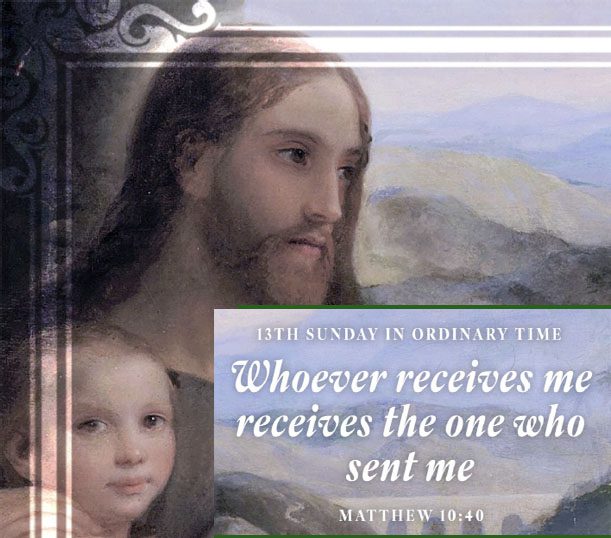
13th Sunday in Ordinary Time
Discipleship Begins Where Self Ends and Christ Becomes the Center of Every Affection
(Thirteenth Sunday in Ordinary Time, Mathew 10:37-42, 28 June 2026)
Today’s liturgy presents to us the last lines of the missionary discourse in Chapter 10 of the Gospel of Matthew (Mathew 10:37-42), by which Jesus instructs the 12 Apostles at the moment in which, for the first time, he sends them on mission to the villages of Galilee and Judea. In this final part, Jesus underscores two essential aspects for the life of a missionary disciple: the first, that his bond with Jesus is stronger than any other bond; the second, that the missionary brings not himself, but Jesus, and through Him the love of the heavenly Father. These two aspects are connected, because the more Jesus is at the center of the heart and of the life of a disciple, the more this disciple is “transparent” to His presence. The two go hand in hand. (Pope Francis, Angelus 2017)
Dear Brothers and Sisters,
The Question of the Human Heart-At the heart of every human life lies a fundamental question: What do I love most? Every decision we make, every sacrifice we embrace, and every direction we take in life is ultimately shaped by the answer to that question. The philosopher Saint Augustine famously wrote: “My heart is restless until it rests in You.” Human beings are creatures of love. We become what we love. The deepest truth about a person is not merely what he thinks, what he owns, or what he accomplishes, but what occupies the center of his heart.
In today’s Gospel (Matthew 10:37-42), Jesus confronts us with one of the most demanding and challenging statements in the New Testament: “Whoever loves father or mother more than me is not worthy of me; and whoever loves son or daughter more than me is not worthy of me.” At first hearing, these words may seem harsh. Is Jesus asking us to love our families less? Is He demanding that we abandon our human relationships? Certainly not. Jesus is teaching a profound spiritual truth: unless God occupies the first place in our lives, every other love becomes disordered. When Christ becomes our first love, every other love finds its proper meaning, direction, and fulfillment.
Pastoral Anecdote: The Lamp and the Family-An elderly parishioner once shared a story about her late husband. Every evening, before dinner, he would quietly go into a small room, kneel before a crucifix, and spend a few minutes in prayer. Their children often wondered why he never missed this daily practice, even on the busiest days. One evening, one of the children asked, “Dad, why do you always pray before spending time with us? Don’t you love us more than anything?” The father smiled and replied, “Precisely because I love you, I must first spend time with Christ. If I forget Him, I will slowly begin to love you selfishly. But when I place Him first, He teaches me how to love you rightly.” Years later, after the father had passed away, the children reflected on his words. They realized that his prayer had never taken him away from the family; it had made him a better husband, father, and grandfather. His love was patient, forgiving, generous, and steadfast because it flowed from a deeper source. The family compared him to a lamp in their home. A lamp can illuminate every room only if it remains connected to its power source. The moment it is disconnected, darkness gradually follows. Likewise, when Christ remains the source of our lives, His light reaches our spouses, children, friends, and neighbors through us. When Christ becomes the heart’s first love, every other love shines with greater beauty and meaning.
The Hierarchy of Love: Why Christ Must Come First-Modern culture often teaches us that freedom means placing ourselves at the center. We are encouraged to seek self-fulfillment, self-expression, and self-interest above all else. Yet the Gospel proposes a radically different vision. The human heart was not created to be its own center. Just as planets revolve around the sun, human life flourishes only when it revolves around God. Saint Thomas Aquinas teaches that every created good points beyond itself to the Supreme Good, who is God. Family, friendships, work, success, and possessions are genuine blessings, but they are not ultimate realities. They are gifts, not the Giver. When finite things occupy the place that belongs to God, disappointment inevitably follows. Many people today suffer not because they love too much, but because they expect from human relationships what only God can provide. We expect spouses, children, careers, or achievements to satisfy the deepest hunger of the soul. Yet no human being can bear the weight of being another person’s ultimate meaning. Jesus therefore calls us to place Him first not because He is jealous of our love, but because He wishes to save our loves from becoming distorted. The more we love Christ, the more authentically we can love others. A Christ-centered heart becomes capable of selfless love, forgiving love, sacrificial love, and enduring love.
Taking Up the Cross: The Cost of Authentic Discipleship-Jesus continues: “Whoever does not take up his cross and follow me is not worthy of me.” Discipleship is not merely admiration of Jesus; it is participation in His way of life. The cross symbolizes much more than suffering. It represents self-giving love. Philosophically speaking, modern society often seeks happiness through comfort, convenience, and avoidance of sacrifice. Yet experience teaches us that the most meaningful realities of life—marriage, parenthood, friendship, priesthood, and service—always involve sacrifice. Love without sacrifice becomes sentimentality. Commitment without sacrifice becomes superficial. Faith without sacrifice becomes merely a cultural identity. The cross reveals the deepest paradox of Christianity: we do not find ourselves by protecting ourselves; we find ourselves by giving ourselves away. This is precisely what Jesus means when He says: “Whoever finds his life will lose it, and whoever loses his life for my sake will find it.” The world says, “Possess your life.” Christ says, “Offer your life.” The world says, “Put yourself first.” Christ says, “Give yourself in love.” The world promises happiness through self-preservation. Christ promises joy through self-gift. The saints throughout history discovered this paradox. The more they surrendered themselves to Christ, the more fully alive they became.
The Missionary Disciple as a Transparent Presence of Christ-Pope Francis beautifully observed that the missionary disciple does not bring himself but brings Christ. This insight is crucial. One of the greatest temptations in ministry and Christian life is to draw attention to ourselves. We want recognition, approval, influence, and success. Yet the Christian disciple is called to transparency. A clean window does not draw attention to itself; it allows the light to pass through. Likewise, a faithful disciple allows others to encounter Christ through him. When people encounter kindness, they should glimpse the kindness of Christ. When they encounter forgiveness, they should glimpse the mercy of Christ. When they encounter hope, they should glimpse the hope of Christ. The more Christ occupies the center of our lives, the less our ego obstructs His presence. This is why holiness is not self-promotion but self-emptying. Saint John the Baptist understood this perfectly when he declared: “He must increase, and I must decrease.” The missionary disciple becomes a living icon through which others encounter the living, Lord.
Hospitality: Welcoming Christ Through One Another-The Gospel concludes with an unexpected emphasis on hospitality: “Whoever receives you receives me, and whoever receives me receives the one who sent me.” Here Jesus reveals a beautiful mystery. God often comes to us through ordinary people. A stranger, a visitor, a lonely neighbor, a suffering parishioner, a grieving widow, an immigrant family, a confused young person—each may become a sacrament of Christ’s presence. This message is especially important in our parish communities today. Many people live surrounded by technology yet experience profound loneliness. Many attend church carrying invisible burdens. Many elderly parishioners feel forgotten. Many families struggle silently with financial pressures, illness, anxiety, and broken relationships. The Gospel challenges us to become communities of welcome. A smile, a conversation after Mass, a visit to the sick, a phone call to someone absent, an invitation to a newcomer—these seemingly small acts become encounters with Christ Himself. The Church grows not primarily through programs but through relationships transformed by charity. Every act of hospitality becomes an extension of God’s embrace.
Bringing the Gospel into Parish Life-The challenge of today’s Gospel is practical. Jesus asks each of us: Who occupies first place in your heart? For some, work may have become the center. For others, wealth, comfort, entertainment, or social approval may occupy that place. Even family, though sacred and precious, can unintentionally become an idol when it replaces God. Christ invites us to reorder our loves. When prayer comes first, family relationships become healthier. When worship comes first, daily work gains deeper purpose. When Christ comes first, fear loses its power. When Christ comes first, generosity replaces selfishness. When Christ comes first, mission replaces complacency. Our parish does not need merely more activities; it needs disciples whose hearts belong completely to Christ. The renewal of the Church begins not with structures but with converted hearts.
Cumulative Summary-Today’s Gospel invites us to examine the deepest affection of our hearts and to place Christ above every other attachment. Jesus does not ask us to love our families less, but to love Him first so that all our relationships may be purified and strengthened by divine love. True discipleship begins when we move beyond self-centeredness and embrace the way of the Cross, which is the path of self-giving love. In a culture that often prioritizes comfort and self-interest, Christ teaches that authentic life is found through sacrifice and service. The missionary disciple is called not to promote himself but to become a transparent witness to the presence of Christ. The more Christ occupies the center of our lives, the more His compassion, mercy, and truth shine through us. Through acts of hospitality, kindness, and welcome, we become instruments of God’s love in a lonely and wounded world. The renewal of our families, parish, and society begins with hearts rooted firmly in Christ. When Christ becomes our first love, every other love finds its true order and meaning. Thus, discipleship flourishes where self ends and Christ reigns as the center of every affection and every mission.
Conclusion: The Secret of True Love-Dear friends, the Gospel today is ultimately not about losing love but about discovering its deepest meaning. Jesus does not ask us to love our families less. He asks us to love Him first so that we may love everyone else better. When Christ becomes the center, every relationship finds its proper place. When Christ becomes the first love of the heart, every other love is purified, strengthened, and elevated.
May we therefore have the courage to place Christ above every attachment, every fear, and every ambition. And may our lives become so transparent to His presence that others, upon encountering us, may encounter Christ Himself. For in the end, discipleship begins where self ends, and true life begins when Christ becomes the center of every affection.
Fraternally,
Fr. John Peter Lazaar SAC, Pastor