


The Most Holy Trinity
Beloved Brothers and Sisters in the Trinitarian Godhead
The Trinity: Love that Begets, is Given, And Makes All Things New
(Most Hoy Trinity Sunday, John 3:16-18, 31 May 2026)
Today, the Solemnity of the Most Holy Trinity, the Gospel is taken from Jesus’ dialogue with Nicodemus (John 3:16-18). Nicodemus was a member of the Sanhedrin, passionate about the mystery of God: he recognizes in Jesus a divine master and goes to speak to him in secret, at night. Jesus listens to him, understands he is a man on a quest, and then first, he surprises him, answering that in order to enter the Kingdom of God, one must be reborn; then, he reveals the heart of the mystery to him, saying that God loved humanity so much that he sent his Son into the world. Jesus, therefore, the Son, speaks to us about his Father and his immense love. (Pope Francis, Angelus, 2023)
The Night of the Seeker: Nicodemus and the Human Condition- The Gospel places before us a profound and intimate encounter: Nicodemus, a man of learning, a seeker of truth, approaches Jesus under the cover of night. This “night” is not merely chronological—it is existential. It represents the interior twilight of the human condition: a world filled with knowledge, yet searching for meaning; surrounded by activity, yet longing for purpose. Nicodemus is homo quaerens—the human being who seeks. And in him, we recognize ourselves, and indeed, many in our parish: those who come quietly, sometimes uncertain, sometimes burdened—elderly persons facing solitude, families navigating uncertainty, individuals who feel distant from the Church yet still carry a hidden hunger for God. Into this night, Christ speaks not merely doctrines, but a mystery: rebirth. “Unless one is born again, he cannot see the Kingdom of God” (Jn 3:3). This is not a biological statement, but an ontological one. It is a call to transformation—to move from mere existence (esse) into fullness of being (plene esse in Deo).
Pastoral Anecdote-One winter evening, I went to visit an elderly parishioner who had not been seen at Mass for many months. Her small house was quiet, almost too quiet—the kind of silence that speaks of absence rather than peace. As we sat together, she said softly, “Father, I used to think God had forgotten me… the days feel long, and no one really comes anymore.” We spoke for a while, and before leaving, I asked if we could pray. As we began, I made the Sign of the Cross slowly: “In the name of the Father, and of the Son, and of the Holy Spirit.” She closed her eyes, and after a moment, tears began to fall. When the prayer ended, she whispered, “I am not alone, am I? God is still here with me.” In that simple moment, the mystery of the Trinity was no longer a doctrine—it became a lived reality. The Father who had never ceased to love her, the Son who had entered her suffering, and the Holy Spirit who now consoled her heart—all were present in that quiet room. As I left, the house was still small, still simple—but no longer empty. For where the Trinity is welcomed, loneliness begins to give way to communion, and even the most forgotten places become filled with the presence of love.
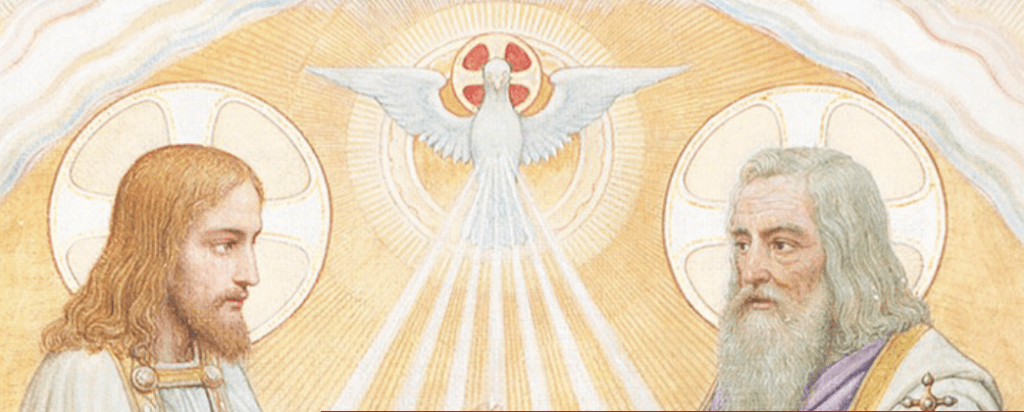
Deus Caritas Est: The Trinity as the Structure of Love-At the heart of today’s Gospel resounds one of the most luminous sentences ever spoken: “For God so loved the world that he gave his only Son” (Jn 3:16). This is not merely a statement about God’s action; it is a revelation of God’s very being. God is not solitary power. God is communion. The Trinity is the eternal dynamism of love: The Father: The One who begets—fons amoris, the source of love; The Son: The One who is given—donum perfectum, the perfect gift; The Holy Spirit: The One who is received and shared—vinculum caritatis, the bond of love. Philosophically, this reveals that reality at its deepest level is not isolation but relation. Being itself is relational. As St. Augustine would say: Amor meus, pondus meum— “My love is my weight.” We are drawn by love because we are made in the image of a Triune God. The Trinity, therefore, is not an abstract puzzle to be solved, but a mystery to be lived.
Against the Boredom of a Godless World: The Trinity as Wonder-One of the great crises of modern life is not merely disbelief, but indifference—a kind of spiritual boredom. When God is pushed to the margins, life becomes flat, repetitive, and ultimately meaningless. In our neighborhoods, this manifests in subtle yet painful ways: Empty pews that once echoed with prayer; Homes where silence is no longer contemplative but lonely; Elderly persons forgotten in the margins of time; Young people searching for identity in a fragmented world. The Trinity stands as a radical contradiction to this boredom. For if God is eternal communion, then reality is not empty—it is overflowing with meaning. To know the Trinity is to rediscover wonder. It is to realize that existence itself is a gift, sustained by love, and directed toward communion.
The Gift that Heals: The Son Sent for the World-“God did not send the Son into the world to condemn the world, but that the world might be saved through him” (Jn 3:17). Here lies the heart of the Christian proclamation: not condemnation, but salvation; not exclusion, but invitation. The Son is sent into the brokenness of our world: Into the loneliness of the elderly; Into the suffering of the sick; Into the quiet despair of those who feel forgotten; Into the disconnection of a shifting neighborhood, Christ does not remain distant. He enters. He accompanies. He redeems. The Cross becomes the supreme revelation of Trinitarian love: the Father gives, the Son offers Himself, and the Spirit is poured out. Love becomes visible, tangible, salvific.
The Spirit: Love Poured into Our Hearts-If the Father is the source and the Son the gift, the Holy Spirit is the presence—the Love poured into our hearts (cf. Rom 5:5). The Spirit transforms fear into courage, isolation into communion, and routine into mission. In a parish like ours—where demographics shift, where participation fluctuates, where fatigue can set in—the Spirit is not an abstract force but a living fire. He calls us: From maintenance to mission; From isolation to encounter; From passive attendance to active witness. The Spirit does not simply comfort; He re-creates. He makes all things new.
The Church: Icon of the Trinity in the World-The Church is not merely an institution, but an icon of the Trinity—a visible sign of invisible communion. When the Church lives authentically: The lonely find a home; The elderly find dignity; The wounded find healing; The searching find truth. But when the Church forgets her Trinitarian identity, she risks becoming a mere organization—efficient perhaps, but lifeless. We are called, therefore, not to be “parochial engineers” managing structures, but “communal cardiologists” healing hearts. The Trinity is our model: Unity without uniformity; Diversity without division; Love without condition
Reborn from Above: The Call to Personal Conversion-Nicodemus came at night—but tradition tells us he did not remain in the night. He moved toward the light. So too are we invited: To move from fear to trust; From routine to renewal; From isolation to communion To be “born again” is to allow the Trinity to reshape our very being—to become, in Christ, sons and daughters of the Father, animated by the Spirit. This rebirth is not a one-time event, but a lifelong journey: formatio ad configuratio, configuratio ad missionem.
The Trinity and the Parish: A Concrete Invitation-What does the Trinity mean for us, here and now? It means: Visiting the sick is not social work—it is participation in divine love; Welcoming the stranger is not courtesy—it is Trinitarian hospitality; Remaining faithful in small acts is not insignificant—it is sacramental. In a neighborhood marked by aging, loneliness, and transition, the Trinity calls us to become a living communion. The question is no longer: What does the parish offer me? But: How do I become, through grace, a gift for others?
Cumulative Pastoral Summary –The Trinity reveals that God is not solitude but communion—Father, Son, and Holy Spirit united in eternal love. Nicodemus represents every human heart searching in the darkness for truth and meaning. Christ invites us not merely to understand but to be reborn into divine life. In a world marked by loneliness, aging, and shifting communities, the Trinity offers not abstraction but healing communion. The Father’s love initiates, the Son’s gift redeems, and the Spirit’s presence renews. The Church becomes an icon of this divine life when it welcomes, heals, and accompanies. The Spirit transforms fear into mission and isolation into encounter. The parish is called to move from maintenance to living communion. Every act of love becomes participation in Trinitarian life. Rebirth in God is a lifelong journey of transformation. The Trinity restores wonder in a bored and fragmented world. Ultimately, we are called not just to believe in the Trinity, but to live it.
Final Contemplation: Living the Mystery-The Trinity is not a problem to be solved, but a mystery to be adored. We stand before it, like Nicodemus, in humble wonder. And perhaps the most fitting response is not explanation, but transformation: To love as the Father loves; To give as the Son gives; To live in communion as the Spirit unites. For in the end, the Trinity is this: Love that begets, love that is given, and love that makes all things new.
Trinitarian Prayer of St. Macarius the Great, (Circa 300–391 Anno Domini) He was a foundational Desert Father of early Christian monasticism: O Eternal God and King of all creation, Who hast granted me to arrive at this hour, forgive me the sins that I have committed today in thought, word and deed, and cleanse, O Lord, my humble soul from all defilement of flesh and spirit. And grant me, O Lord, to pass the sleep of this night in peace, that when I rise from my bed, I may please Thy most holy Name all the days of my life and conquer my flesh and the fleshless foes that war with me. And deliver me, O Lord, from vain and frivolous thoughts, and from evil desires which defile me. For Thine is the kingdom, the power and the glory of the Father, Son and Holy Spirit, now and ever, and to the ages of ages. Amen.
Fraternally,
Fr. John Peter Lazaar SAC, Pastor