








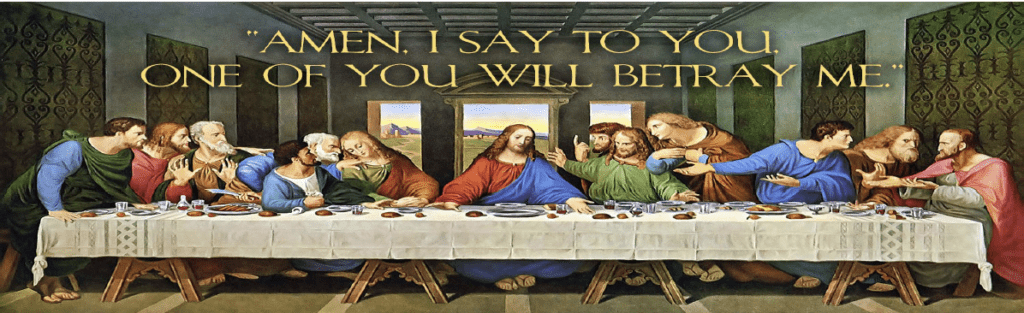
Holy Thursday of the Lord’s Supper
To The Epiphany Family
Cena Domini
In Cena Domini: Amor usque ad finem servit: At the Lord’s Supper: Love Serves to the End
(Holy Thursday of the Lord’s Supper, 02 April 2026)
In the course of a meal, he washed their feet and gave them the commandment of love. In order to leave them a pledge of this love, he instituted the Eucharist as the memorial of his death and Resurrection and commanded his apostles to celebrate it until his return. (Catechism of the Catholic Church, 1337)
Dear Brothers and Sisters of Epiphany: The Upper Room and Our Empty Rooms- The liturgy of Holy Thursday draws the Church into the profound mystery of the Upper Room, where Christ reveals the essence of divine love in a moment both historical and ever-present. In a world marked by loneliness, aging populations, sickness, and the quiet reality of emptying pews and shifting neighborhoods, this sacred evening becomes deeply existential.
The Upper Room is no longer confined to the past; it becomes a living interpretive key for our present condition. The silence of homes where the elderly wait, the absence felt in once vibrant communities, and the hidden suffering of those left behind all converge in this liturgical moment. It is precisely here that Christ’s action—rising from the table and kneeling to wash the feet of His disciples—speaks with renewed force. It reveals that God does not remain distant from human fragility, but enters into it with tenderness and purpose.
Anecdote: “The Priest Who Knelt”-In a quiet parish much like our own, an elderly man lived alone at the edge of the neighborhood. He had once been a regular at Sunday Mass, but age, illness, and the slow fading of strength kept him confined to his home. Over time, his absence became unnoticed; the pew he once occupied remained empty, and life in the parish moved on.
One Holy Thursday, the parish priest decided to visit him. The house was dim, the air heavy with silence. The old man, surprised, said softly, “Father, I thought the Church had forgotten me.” Without many words, the priest brought a small basin and a towel. There, in that quiet room, far from the altar and the gathered assembly, he knelt and gently washed the old man’s feet. Tears filled the man’s eyes as he whispered, “Now I know God has not forgotten me.”
Later, the priest would say, “That day, I understood Holy Thursday more than I ever had at the altar. The Eucharist had led me there—to kneel where Christ was waiting.”
An Insight –“Christ does not wash only the feet of those in the Upper Room; He continues to kneel wherever a human life feels forgotten. And every time we bend in love before another, the Upper Room is made present again.”
The Gesture that Reveals God-The Catechism of the Catholic Church reminds us that “in the course of a meal, he washed their feet and gave them the commandment of love [and] instituted the Eucharist as the memorial of his death and Resurrection” (Catechism of the Catholic Church 1337).
This gesture of washing the disciples’ feet is not merely moral instruction; it is theological revelation. It discloses a God who bends low, who embraces the dust of human existence without hesitation.
In a culture that often marginalizes the elderly, overlooks the sick, and forgets those who no longer seem productive, this act becomes a radical corrective. It proclaims that dignity is not grounded in usefulness but in being loved by God. Thus, amor usque ad finem servit is not a poetic phrase, but the very truth of divine being: love that stoops, love that serves, love that remains faithful to the end.
The Eucharist: Presence in Absence-Simultaneously, the institution of the Eucharist reveals the enduring presence of Christ within history. The Eucharist is not merely a symbolic remembrance but a real and abiding presence, especially in moments of human absence.
In communities where pews grow emptier and relationships become more fragile, the Eucharistic mystery becomes even more luminous. It assures us that God does not withdraw when human presence diminishes. Rather, He intensifies His nearness. The altar becomes the place where absence is transformed into presence, where the loneliness of the human heart encounters the fidelity of divine love. In the Eucharist, Christ remains: when we drift, He stays; when we forget, He remembers; when community weakens, He gathers.
Loneliness Transfigured into Communion-Contemporary society suffers not only from material poverty but from a profound poverty of belonging. Many are surrounded by activity yet deprived of meaningful presence; many live long lives yet feel unseen and unheard.
Holy Thursday speaks directly into this wound. The Eucharist is the sacrament that gathers what the world disperses. It forms communion where isolation prevails and restores relational meaning where fragmentation dominates. It proclaims to every lonely heart that no life is invisible before God.
Moreover, it calls the Church to become what it celebrates: a community not of spectators but of mutual belonging. In this way, loneliness is not merely alleviated but transfigured into communion.
The Commandment That Builds the Church-At the heart of this liturgy stands the commandment of Christ: “Love one another as I have loved you” (John 13:34). This is neither a suggestion nor a sentiment, but a definitive form of Christian existence. To love as Christ loves is to embrace a spirituality of attentive presence—one that resists indifference and overcomes isolation. It means drawing near to the sick, accompanying the elderly, and remaining with those who feel forgotten.
The renewal of the Church in our time will not arise primarily from structural strategies or numerical growth, but from a rediscovery of this commandment lived concretely. A parish is rebuilt through acts of love that restore trust, presence, and communion—one relationship at a time.
The Priesthood: A Life Poured Out-Within this Eucharistic context, the ministerial priesthood reveals its deepest identity. Instituted on this very night, the priesthood is intrinsically linked to both the altar and the basin—to sacrifice and service. The priest stands at the altar to consecrate, yet he must also kneel to serve; his life is called to take on a Eucharistic form. He becomes a pontifex, a bridge between divine grace and human need.
In a fragmented and often impersonal world, the priest is called to embody a presence that gathers, accompanies, and sustains. His vocation is not reducible to function but is defined by self-gift: to be broken, given, and poured out for the life of the community, especially for those most easily forgotten.
The Night That Continues-Holy Thursday does not conclude with the liturgy; it extends into the silence of the night and into the mystery of Gethsemane. This continuation invites the faithful into a spirituality of watchfulness and accompaniment. To remain with Christ is to remain with Him in those places where suffering persists—in the homes of the lonely, in hospital rooms, and in the quiet endurance of the aged.
The vigil becomes not only a liturgical act but an existential posture. Every act of presence, every refusal to abandon another, becomes a participation in the prayer of Christ who asks: “Could you not watch one hour with me?” (Mathew 26:40).
Cumulative Summary-Holy Thursday calls us to rediscover the power of presence in a world marked by absence. We are invited to move from being passive attendees to active bearers of Christ’s love. The empty pew is not only a loss to lament, but a call to seek out those who are missing. Every parishioner becomes a missionary of proximity, not waiting but going forth.
The elderly in our neighborhoods are not burdens, but living sanctuaries of memory and faith. To visit them is to kneel where Christ Himself is already present. The sick are not to be avoided, but accompanied with patience and tenderness. A simple visit, a phone call, or a shared prayer becomes a Eucharistic extension. Loneliness must not be normalized; it must be gently interrupted by communion. We are called to notice who is absent, who is silent, who is slowly drifting away. Christian love begins with attention—the courage to truly see another. Families are invited to reclaim the table as a place of encounter, not isolation.
Parish life must shift from maintenance to mission, from routine to relationship. Small acts of care rebuild what large programs cannot restore. Hospitality at the doors of the Church must become hospitality of the heart. The Eucharist we receive must become the love we give. We cannot adore Christ in the Host and ignore Him in the lonely. The commandment of love takes flesh in concrete, ordinary gestures. Priests and faithful together are called to form a culture of accompaniment. No one in the parish should feel unseen or unremembered. Suffering shared becomes lighter; presence offered becomes healing. The Church grows not first by numbers, but by depth of communion. Each home can become a small Upper Room where love is lived. Each act of service becomes a continuation of Christ washing feet. Thus, even in fragile communities, love can still serve to the end.
Concluding Word: Love Until the End-In conclusion, the gifts of Holy Thursday—the Eucharist, the priesthood, and the commandment of love—are not separate realities but dimensions of one unified mystery: divine love made visible, sacramental, and mission-oriented. In a world marked by absence, Christ becomes presence; in a world marked by loneliness, He becomes communion; in a world marked by departure, He remains.
The Church is entrusted with making this presence tangible in concrete acts of love. Thus, even amid empty pews, aging communities, and hidden suffering, the mystery of this night continues to unfold. The final word is not decline or absence, but fidelity: amor usque ad finem servit—love serves to the end:
Crucified Jesus knelt where dust and weariness remain,
The Lord of all, in love that does not reign by might.
He touched the feet the world would pass in silence,
And turned forgotten lives into His light.
So must we kneel where loneliness is hidden,
And find in wounds the place where grace begins;
For every act of love that stoops in mercy
Makes Christ alive in us—and washes sins.
Fraternally,
Fr. John Peter Lazaar SAC, Pastor